


Paying for premium digital subscriptions every month can become expensive, especially when you need several tools for work, school, business, or content creation. From productivity software to AI tools and design platforms, subscription fees can quickly take up a significant part of your monthly budget.
But what if you could access these tools without paying the full subscription price yourself?
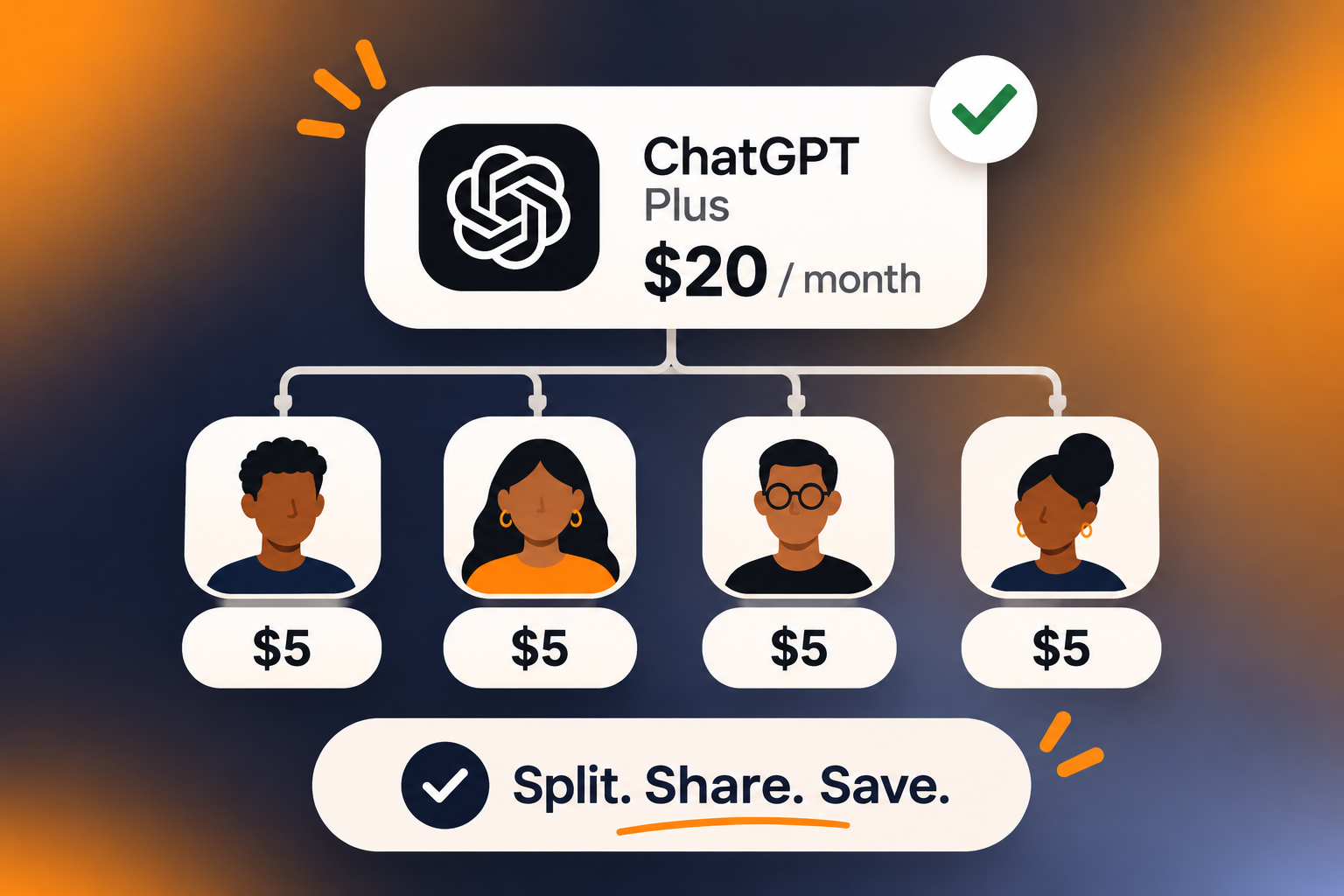
Sharing eligible subscriptions with other people is one practical way to reduce digital expenses. Instead of one person paying the entire bill, several members contribute towards the cost and enjoy the benefits of a shared plan.
However, splitting subscription costs is not always as simple as dividing a bill by the number of people involved. Differences in usage, payment delays, account restrictions, and unexpected price changes can create disagreements if everyone does not understand the arrangement.
In this guide, you will learn how to split subscription costs fairly, calculate everyone's contribution, avoid common mistakes, and make subscription sharing more affordable and secure.
1. Understand How Subscription Sharing Works
Before deciding how much everyone should pay, understand how the subscription sharing arrangement works.
Some digital services offer family plans, while others provide team plans or multiple-user subscriptions. These plans allow eligible members to access a service under specific conditions, although the rules differ between providers.
For example, a team plan might allow several people to access a software product through individual accounts, while a family plan might restrict membership to people within the same household.
If you are new to the concept, read our guide on how subscription sharing works for Nigerians to understand the basics before joining a shared subscription.
It is also important to distinguish between legitimate subscription sharing and simply distributing one person's login details to several people. Sharing must follow the service provider's rules, including any restrictions on household membership, account access, and geographical eligibility.
Understanding these conditions helps you choose a suitable plan before asking anyone to contribute money.
2. Divide the Total Cost Equally When Everyone Gets the Same Benefits
The simplest way to split a subscription cost is to divide the total price by the number of people sharing it.
Suppose a subscription costs ₦12,000 per month and allows four eligible members to access the service.
If everyone agrees to contribute equally, the calculation is:
₦12,000 ÷ 4 = ₦3,000 per person.
Instead of paying ₦12,000 alone, each member pays ₦3,000 monthly.
Here is how the same subscription cost would be divided among different group sizes.
| Number of members | Monthly cost per person |
|---|---|
| 2 | ₦6,000 |
| 3 | ₦4,000 |
| 4 | ₦3,000 |
| 5 | ₦2,400 |
| 6 | ₦2,000 |
These figures assume that the subscription costs ₦12,000 in total and that the plan permits the stated number of members without additional fees.
Equal splitting works best when everyone receives comparable access and agrees to contribute the same amount.
If you want to understand the difference between subscriptions designed for individuals and those intended for multiple users, read our guide on team plans versus individual plans.
The cheapest option is not always the best. Compare the available features, access limits, and total price before deciding which plan offers the best value.
3. Decide Whether an Equal Split Is Actually Fair
Although an equal split is straightforward, it does not automatically make every arrangement fair.
Imagine that three freelancers share an eligible subscription. One person uses the tool every day for client projects, another uses it a few times a week, and the third only needs it occasionally.
Should all three pay the same amount?
It depends on the plan and what everyone has agreed to.
If all members receive the same access and the subscription has a fixed price regardless of usage, an equal split is usually the easiest option. Everyone pays the same amount for the same entitlement.
However, if members receive different access levels or the plan offers different paid seats, you might agree on contributions that reflect those differences.
For example, someone with access to additional features may reasonably pay more than someone with a restricted seat, provided the pricing arrangement is transparent and allowed by the provider.
Avoid making the calculation unnecessarily complicated by tracking every login or minute of usage. For most small groups, a clear agreement is more useful than a complicated pricing system.
4. Check the Rules Before Sharing a Family or Team Plan
One of the most common mistakes people make is assuming that every subscription can be shared with anyone.
That is not always true.
Some family plans restrict membership to people who live together. Some team plans require each member to be added through an official invitation, while certain services prohibit account sharing entirely.
Before contributing money, check whether your intended arrangement complies with the provider's rules.
Our guide to family plan rules and who can join explains why eligibility matters when choosing a shared plan.
You should also understand the distinction between family and team subscriptions. Read family plans versus team plans to learn how their intended uses and membership conditions can differ.
Do not assume that a subscription becomes shareable simply because it supports multiple users. The provider's current terms determine who is eligible to join.
5. Agree on Payment Deadlines Before the Subscription Renews
Payment delays can turn an otherwise useful subscription arrangement into a source of frustration.
Imagine that you manage a subscription costing ₦12,000 monthly. Three other people agree to contribute ₦3,000 each, but one person regularly delays payment.
You may have to cover the missing amount to prevent the subscription from expiring, even though everyone agreed to share the cost.
The easiest way to prevent this problem is to establish a payment schedule before anyone joins.
Agree on:
How much each person must contribute.
The deadline for monthly payments.
Who is responsible for coordinating payments.
What happens when a member fails to pay.
How changes in the subscription price will be handled.
For example, if the subscription renews on the 25th of each month, the group could set the 22nd as the payment deadline.
This gives everyone time to confirm contributions before renewal.
If you are considering joining a shared plan through Cluumo, our guide on how Cluumo works: join, pay, get your seat explains the basic process of joining a plan and securing your seat.
Clear payment expectations help prevent disagreements and ensure that one person does not repeatedly carry the financial burden for everyone else.
6. Make Sure Everyone Understands the Total Cost
Transparency is essential when several people contribute towards one subscription.
Everyone should know the actual price, the billing period, and any additional charges that affect the amount they need to pay.
Suppose a subscription originally costs ₦10,000 per month but increases to ₦12,000.
If four people share the cost equally, each person's contribution rises from ₦2,500 to ₦3,000.
The group should communicate this change before collecting the next payment.
The same applies when an introductory discount expires, an exchange-rate change affects the price, or the provider introduces additional charges.
For Nigerian users, understanding the available payment methods can also make budgeting easier. Our guide on how to pay for subscriptions in naira explores this subject.
If you need access to digital services that normally require international payments, you may also find our article on how to pay for digital tools without a dollar card useful.
The goal is to ensure that everyone understands what they are paying for and why their contribution may change.
7. Choose a Safe Way to Join the Subscription
Fair pricing means little if you lose access to the subscription or expose your personal information in the process.
Before joining a shared plan, find out who manages the subscription, how members are added, and what happens if the main account owner stops paying.
Where possible, use the provider's official invitation and account-management features rather than sharing one password among several people.
Our guide on safer ways to join a plan without sharing your password explains why account security should be part of your decision.
You should also understand what a subscription slot means before paying for one. Read what a subscription slot is and how to buy one safely to learn more about joining an existing multi-user plan.
Before joining, ask yourself these questions:
Is the subscription plan legitimate?
Am I eligible to join under the provider's rules?
Will I receive the access that was promised?
Can I protect my personal files and account information?
What happens if my access is interrupted?
Do not assume that a low price guarantees a safe arrangement. Verify the plan and understand the terms before paying.
8. Understand How Your Money Is Protected
When you pay someone to arrange access to a shared subscription, you should understand what happens to your money if the arrangement does not work as expected.
For example, what happens if the promised seat is never provided? What if access disappears before the agreed period ends?
These are important questions to ask before making a payment.
If you are using a subscription-sharing marketplace, understand its payment and dispute-resolution process rather than relying entirely on informal promises.
Our article on how escrow protects you when buying a shared plan explains the role escrow can play in protecting transactions.
You can also read how payment is held until your month ends to understand Cluumo's approach to payment protection.
For additional information, our guide on whether Cluumo is legitimate and how we protect your money covers trust and safety considerations.
Remember that payment protection depends on the platform's actual terms, procedures, and dispute rules. Read those details before committing your money.
9. Decide What Happens When Someone Leaves
People's needs change. A student might finish a course, a freelancer might stop using a particular tool, or a team member might move to another project.
When someone leaves a shared subscription, the remaining members may need to adjust their contributions.
Suppose four people share a ₦16,000 monthly subscription, paying ₦4,000 each.
If one person leaves and the total price remains ₦16,000, the remaining three would need to contribute approximately ₦5,333 each to maintain the same arrangement.
That is a significant increase, so the group should discuss its options before automatically transferring the departing member's share to everyone else.
Possible solutions include:
Finding another eligible member to replace the departing person.
Moving to a cheaper plan if one meets everyone's needs.
Cancelling the subscription if the cost is no longer worthwhile.
Agreeing on revised contributions before the next renewal.
The group should also establish how outstanding payments and unused billing periods will be handled.
A clear exit policy makes it easier for members to leave without creating unnecessary financial disagreements.
10. Review Your Subscription Spending Regularly
Sharing subscriptions can reduce costs, but it does not automatically mean you are spending wisely.
If you pay for several services you rarely use, you could still waste money even when each subscription seems affordable.
Review your subscriptions at least once every few months.
List each service, how much you pay, how often you use it, and whether it provides enough value to justify the expense.
If you discover that you are paying for tools with overlapping features, consider keeping only the ones you genuinely need.
For more practical ways to reduce your digital expenses, read our guide on seven smart ways to cut your monthly app spending in naira.
You can also explore how to get premium apps for less in Nigeria legally for more ideas on making digital services affordable without ignoring their terms.
The objective is not to subscribe to as many services as possible. It is to get the tools you need at a price that makes sense for your budget.
11. Keep a Record of Everyone's Contributions
Even a small group can benefit from a simple payment record.
You do not need expensive accounting software. A spreadsheet or shared note may be enough to track each person's contribution and the next renewal date.
For example:
| Member | Monthly contribution | Payment status |
|---|---|---|
| Member A | ₦3,000 | Paid |
| Member B | ₦3,000 | Paid |
| Member C | ₦3,000 | Pending |
| Member D | ₦3,000 | Paid |
This record makes it easy to see who has paid and who still owes money.
If you are managing a subscription plan yourself and want to make better use of unused seats, read our guide on how to earn from the empty seats on your plan.
For people who want to organize their subscriptions through Cluumo, the platform provides another option for exploring shared plans instead of coordinating every arrangement informally.
Visit Cluumo to learn more about the platform and its subscription-sharing approach.
Common Mistakes to Avoid When Splitting Subscription Costs
Before joining or organizing a shared subscription, watch out for these common mistakes.
Assuming every subscription allows sharing. Always check the provider's current rules and membership requirements.
Ignoring payment deadlines. Set a clear deadline before the renewal date so the group has time to confirm contributions.
Failing to communicate price increases. Tell members about changes before asking them to pay a higher amount.
Sharing passwords unnecessarily. Use official member invitations and individual accounts where available.
Forgetting about cancellation and exit rules. Agree on what happens when a member leaves or the subscription is no longer useful.
Choosing a plan based only on price. Compare features, access conditions, security, and total cost before deciding.
Paying without understanding the arrangement. Confirm what you will receive, how long your access will last, and what happens if something goes wrong.
Subscription sharing works best when everyone understands the terms, responsibilities, and costs from the beginning.
Frequently Asked Questions
How do you split subscription costs fairly?
Divide the total subscription cost by the number of eligible members when everyone receives comparable access. If members receive different benefits, agree on a transparent alternative that reflects those differences.
Is it better to split subscription costs equally or based on usage?
An equal split is generally simpler when everyone receives the same access. A usage-based split may be appropriate when usage or benefits differ substantially, but it should be practical to calculate and agreed upon by everyone.
Can I split subscription costs with friends?
That depends on the subscription provider's terms. Some plans allow sharing among friends, while others restrict membership to a household or organization. Check the rules before making payment.
What happens if someone stops paying?
Follow the group's agreed payment rules and the provider's terms. Depending on the arrangement, the group might replace the member, revise contributions, or move to another plan.
How can I save money on digital subscriptions in Nigeria?
Compare individual and multi-user plans, use eligible sharing options, review your recurring expenses, and choose services that provide genuine value. Always check the plan's rules before joining.
Is subscription sharing always cheaper?
No. The savings depend on the total plan price, the number of eligible members, additional fees, and the features available. Calculate the actual cost per person before committing.
Final Thoughts
Splitting subscription costs fairly is about more than dividing a bill. It requires choosing the right plan, understanding its rules, agreeing on payment deadlines, protecting account access, and making sure everyone knows their responsibilities.
When managed properly, subscription sharing can help students, freelancers, creators, and businesses access useful digital tools without paying the full price individually.
Start with a simple agreement, keep contributions transparent, and review the arrangement whenever prices or people's needs change.
If you are looking for a more affordable way to access eligible premium digital subscriptions, visit Cluumo and explore how subscription sharing can help you make better use of your digital budget.